


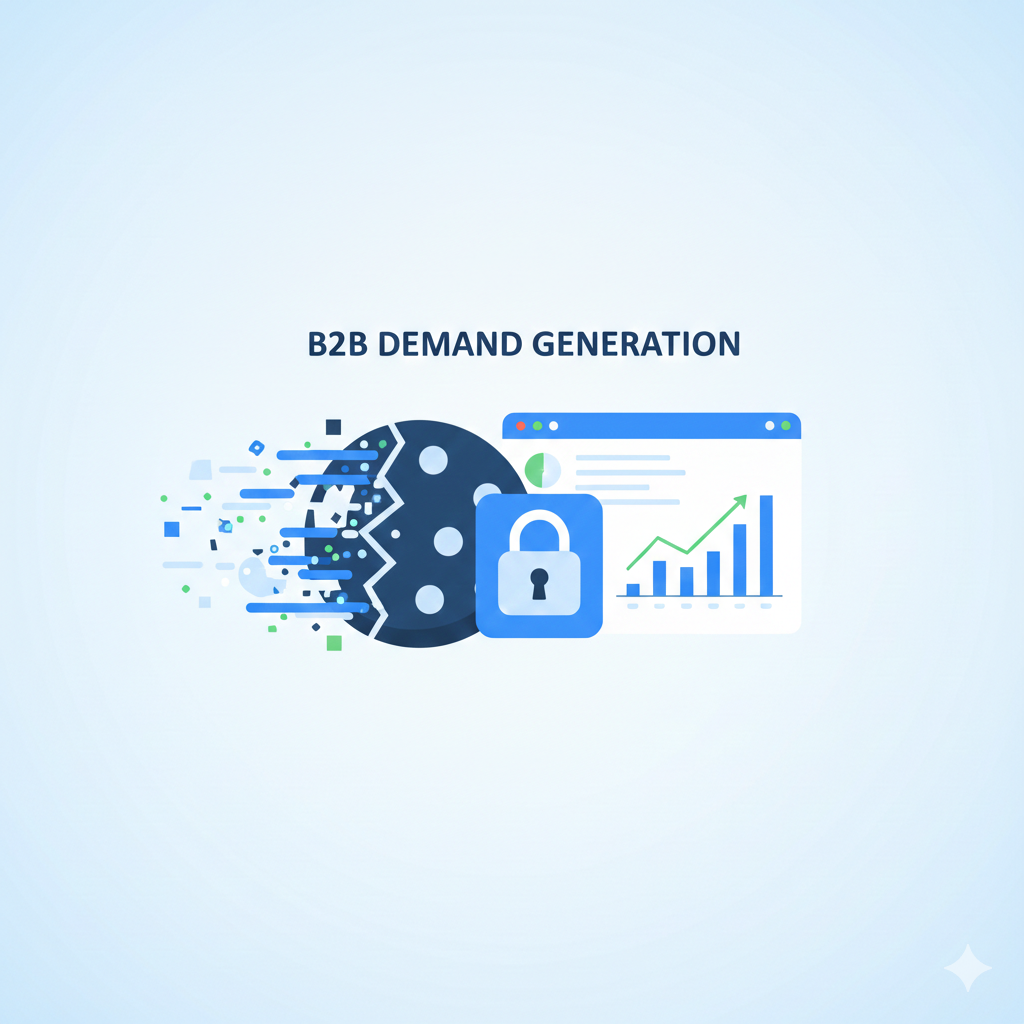

The digital marketing ecosystem is undergoing a structural transformation. As third-party cookies phase out across major browsers, businesses must rethink how they attract, nurture, and convert prospects. For organizations that rely heavily on targeted campaigns and attribution modeling, this shift has significant implications.
However, the so-called “Cookie Apocalypse” does not signal the end of growth. Instead, it marks a turning point for B2B Demand Generation. Companies that adapt quickly will build stronger customer relationships, improve data ownership, and develop more resilient marketing systems.
In this article, we examine how the decline of third-party cookies impacts B2B Demand Generation, what strategic shifts are required, and how organizations can future-proof their marketing infrastructure.
Understanding the Cookie Apocalypse
Third-party cookies are small tracking files placed in a user’s browser by external domains, often advertising networks or analytics providers. These cookies allow marketers to track user behavior across multiple websites, enabling retargeting and cross-platform attribution.
Browsers such as Google, Apple, and Mozilla have progressively restricted or eliminated third-party cookies. Meanwhile, global privacy regulations such as GDPR and India’s Digital Personal Data Protection Act have reinforced stricter data governance.
Consequently, marketers can no longer depend on traditional cross-site tracking methods.
Why the Shift Matters for B2B Demand Generation
Historically, B2B Demand Generation relied on:
- Behavioral retargeting
- Multi-touch attribution
- Audience lookalike modeling
- Cross-platform tracking
Now, as third-party cookies disappear, marketers lose visibility into buyer journeys across external domains. This loss affects lead scoring accuracy, campaign measurement, and personalization depth.
However, the transformation also presents an opportunity. Companies can now shift from rented data ecosystems to owned data infrastructures.
From Third-Party to First-Party Data Strategy
The future of B2B Demand Generation depends on first-party data, information collected directly from prospects through owned channels.
Examples of First-Party Data:
- Website registrations
- Webinar sign-ups
- CRM interactions
- Email engagement
- Content downloads
Instead of tracking anonymous users across the internet, companies must encourage direct engagement.
Therefore, successful B2B organizations now focus on:
- High-value gated content
- Interactive tools and calculators
- Account-based marketing (ABM) campaigns
- Community-driven engagement
As a result, marketing shifts from passive tracking to active value exchange.
The Rise of Privacy-First Marketing
Privacy is no longer a compliance checkbox. It has become a competitive differentiator.
According to research from McKinsey & Company, consumers and business buyers increasingly prefer brands that demonstrate transparency in data handling.
Therefore, B2B Demand Generation must prioritize:
- Transparent consent mechanisms
- Clear privacy policies
- Ethical data collection practices
- Secure CRM systems
When companies build trust, they strengthen long-term pipeline sustainability.
Impact on Retargeting and Advertising
Without third-party cookies, retargeting strategies must evolve.
Previously, marketers relied on ad networks to identify users across multiple websites. Now, platforms emphasize contextual advertising and first-party audience segmentation.
For example, professional networks such as LinkedIn provide robust first-party data targeting options. Instead of cookie-based retargeting, marketers can use platform-native insights and CRM integration.
Moreover, contextual advertising, serving ads based on page content rather than user history, is regaining importance.
Account-Based Marketing (ABM) Becomes Central
Account-Based Marketing aligns perfectly with the post-cookie era. Rather than targeting anonymous individuals, ABM focuses on specific high-value accounts.
Modern B2B Demand Generation now integrates:
- Predictive intent data
- CRM-enriched firmographics
- Personalized landing pages
- AI-driven engagement scoring
Because ABM relies heavily on first-party intelligence, it aligns naturally with privacy regulations.
Attribution Modeling in a Cookieless World
One of the most significant challenges is attribution.
Traditional multi-touch attribution relied on cross-site tracking. Now, marketers must adopt alternative models such as:
- Marketing mix modeling (MMM)
- First-party analytics
- Server-side tracking
- Data clean rooms
Consulting firms like Deloitte emphasize that companies must combine statistical modeling with CRM insights to maintain measurement accuracy.
Although attribution becomes more complex, it also becomes more strategic.
AI and Predictive Analytics in B2B Demand Generation
Artificial intelligence plays a crucial role in this transition.
Without cookies, companies depend more heavily on predictive analytics powered by owned data. AI tools can analyze CRM records, email interactions, and engagement signals to forecast buying intent.
For instance, marketing automation platforms integrate AI-driven lead scoring to prioritize high-value prospects.
Consequently, B2B Demand Generation becomes smarter and more data-centric.
India’s Opportunity in the Cookieless Era
For Indian B2B companies, the cookie phaseout creates a level playing field.
Previously, large multinational firms dominated paid retargeting ecosystems. Now, companies that invest in:
- Strong content marketing
- SEO-driven inbound traffic
- Community building
- Thought leadership
can compete effectively.
Furthermore, compliance with India’s evolving data protection regulations enhances global credibility.
Content Marketing as a Core Growth Engine
In a cookieless world, content marketing becomes the backbone of B2B Demand Generation.
Instead of chasing anonymous traffic, companies must:
- Publish high-value whitepapers
- Host expert webinars
- Create research-driven blog posts
- Offer downloadable industry reports
High-quality content encourages voluntary data sharing.
Therefore, SEO, organic search optimization, and long-form educational assets gain renewed importance.
Sales and Marketing Alignment
As tracking becomes limited, collaboration between sales and marketing becomes critical.
Marketing teams must:
- Share CRM insights with sales
- Align qualification criteria
- Optimize lead nurturing sequences
Meanwhile, sales teams must provide feedback on lead quality and conversion patterns.
When alignment improves, B2B Demand Generation efficiency increases significantly.
Technology Stack Optimization
Organizations must audit their martech stack to ensure compatibility with privacy-first strategies.
Essential components include:
- CRM platforms
- Customer data platforms (CDPs)
- Consent management systems
- Secure analytics tools
- Marketing automation software
By centralizing first-party data, companies reduce dependency on external tracking ecosystems.
Strategic Recommendations for B2B Leaders
To thrive in the cookieless era, decision-makers should:
- Strengthen first-party data collection strategies
- Invest in AI-powered analytics
- Enhance account-based marketing programs
- Focus on high-quality content marketing
- Prioritize compliance and transparency
Moreover, leaders must continuously monitor regulatory changes and technological advancements.
The Future of B2B Demand Generation
The Cookie Apocalypse marks a shift toward more mature marketing systems.
B2B Demand Generation will increasingly rely on:
- Data ownership
- Relationship-based engagement
- AI-driven personalization
- Privacy-centered growth strategies
Rather than tracking anonymous visitors, companies will cultivate meaningful interactions with verified prospects.
Ultimately, the future belongs to organizations that treat data as a trust asset rather than a tracking mechanism.
Conclusion
The decline of third-party cookies challenges traditional marketing models. However, it also unlocks significant opportunities.
By embracing first-party data, strengthening privacy frameworks, and leveraging AI analytics, companies can elevate B2B Demand Generation strategies beyond outdated tracking methods.
Forward-thinking organizations will not merely survive the Cookie Apocalypse, they will redefine how sustainable growth happens in the digital economy.